
The six drivers behind a multi-turn valuation spread, and how owners close the gap before going to market.
The Anchoring Problem
Every advisor in this industry has had the same conversation. An owner calls, and before we get to the numbers, they tell us about the operator who sold for more than 12x. They have already done the math on their own wash at that multiple, and that number is now the floor in their head.
Here is what the story leaves out. We recently ran a sell-side process for a multi-site express platform. More than 30 buyers reviewed the opportunity. Same wash, same financials, same market. The spread between the lowest indication and the final letter of intent was measured in full turns of EBITDA, not decimals. If a single asset can attract bids that far apart in the same process, then the multiple your neighbor got tells you little about what your wash is worth.
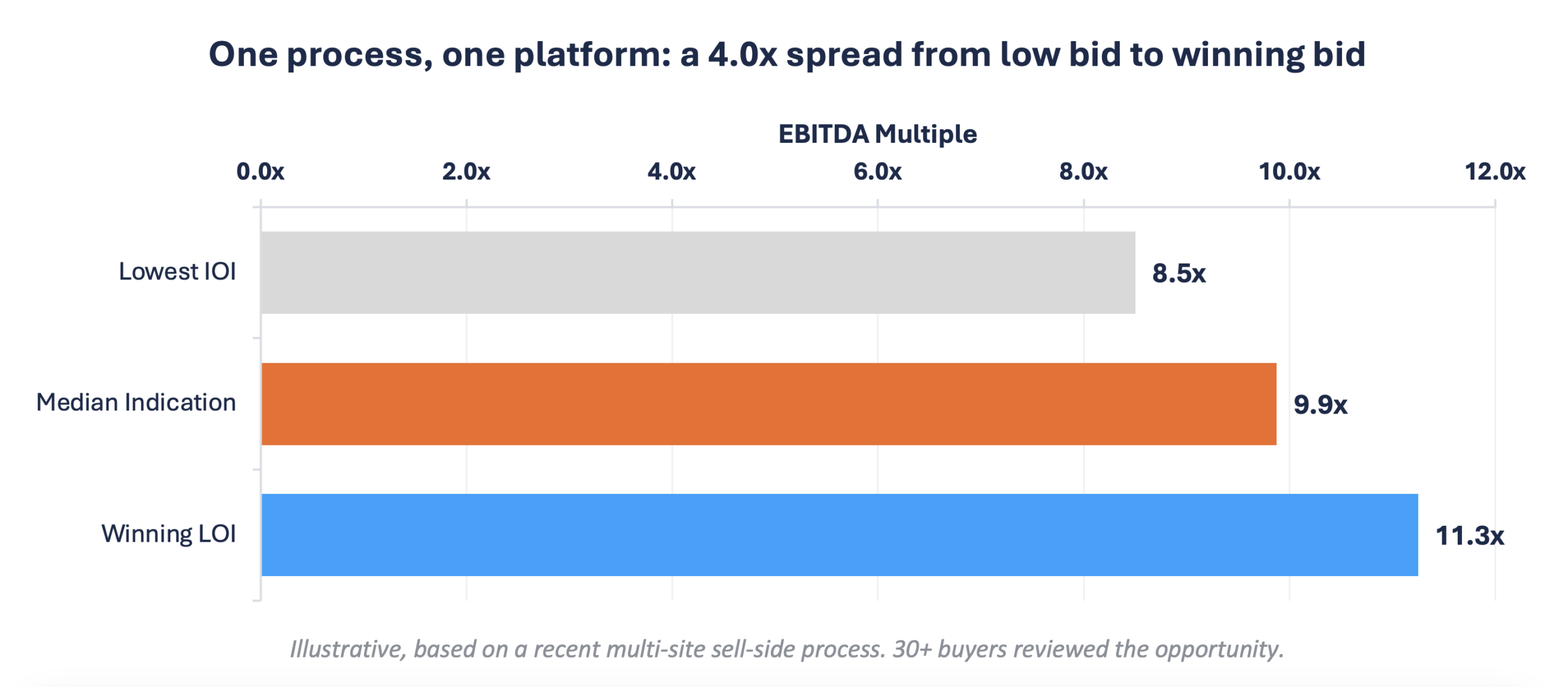
To put that spread in dollars: on $2,000,000 of adjusted EBITDA, a single turn is $2,000,000 of purchase price. A 2.75x spread on that same wash is a $5,500,000 difference between the buyer who wanted it least and the buyer who wanted it most. That spread only becomes visible — and only becomes yours to capture — in a structured process. Negotiating with a handful of groups, formally or informally, you never learn where the top of the range was.

What a Multiple Actually Prices
Buyers do not pay for EBITDA. They pay for cash flow they believe will still be there long term, under their ownership, without you in the picture. The multiple is their confidence score on that belief based on the composition and characteristics of your business.
This is why the market feels different than it did in 2021 and 2022. During the peak of the consolidation wave, platforms were underwriting growth stories and paying for potential. Capital was cheap and the race for density covered a lot of sins. That era set the multiples owners still quote at dinner. Today the buyer universe is more disciplined. Cost of capital is real, underwriting is tighter, and buyers are paying for what a wash has proven, not what a deck or owner says it could do.
The good news for owners is that confidence can be built. Every question a buyer asks in diligence is really the same question: how sure am I that this cash flow survives the transition? The more of those questions your business answers cleanly, the more turns you capture in your multiple.
Six Important Drivers of Car Wash Multiple Spread
From what we have seen across our recent processes, six key factors explain most of the gap between a low bid and a high bid.
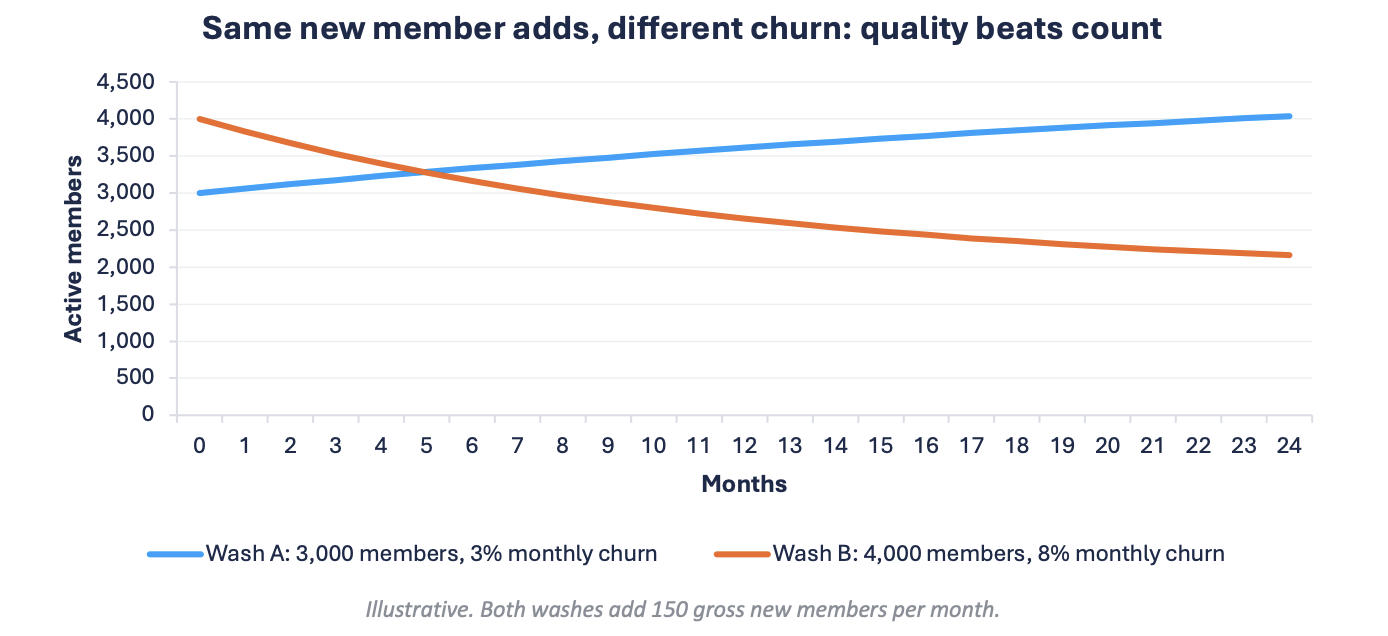
1. Membership quality, not membership count. Every news outlet and podcast in this industry touts membership penetration. Sophisticated buyers go a level deeper: churn by cohort, average revenue per member, and whether growth came from price increases or from new members. A wash with 3,000 members churning 3 percent a month will out-trade a car wash with 4,000 members bleeding 9 percent a month, every time. The chart below shows why. Both washes add the same 150 new members every month. Within a year, the smaller wash with better retention is the bigger wash.
2. The real estate answer. Whether you own or lease,and on what terms, changes the buyer math entirely. Owned real estate gives buyers sale-leaseback optionality and gives you a second negotiation lever. A short lease with no extensions does the opposite. There is no universally right structure, but there is a right structure for your exit, and it needs to be resolved before you go to market, not during diligence.
3. Market protection. Buyers underwrite competition harder than owners expect. A strong wash in a market with three express sites under construction nearby will get discounted for a fight it has not lost yet. Traffic counts, zoning friction, and how much of your volume sits inside a defensible trade area all feed the confidence score.
4. Margin consistency across sites. On multi-site platforms, buyers find your weakest site fast. One underperforming location drags the blended multiple because buyers price the portfolio off the question marks, not the trophies.
5. Financial credibility. This one is so decisive it gets its own section below. Clean books are not a nice-to-have. They are the difference between a buyer underwriting your numbers and a buyer discounting them.
6. Regional density is a moat, and buyers pay for moats. A single strong wash in a market anyone can enter is a good business. Three or four washes covering the same metro is something a competitor must build around. Density gives you the local brand, a membership base that washes across all your sites, and marketing efficiency a new entrant cannot match on day one. It also changes who shows up to buy. Consolidators are not buying tunnels, they are buying position in a region, and a cluster that would take them three years and a dozen permits to replicate is worth paying up for. The reverse holds too. Four sites scattered across four markets read as four separate underwriting problems rather than one platform.
One more point sits underneath all six. On a recent platform we advised, buyer fit moved the outcome as much as any single driver. Several sites went to a strategic consolidator that valued the density, and a single location went to a private buyer who valued it differently. Same seller, same process, two different buyers paying for two different things. Running a real process is how you find the buyer whose confidence score on your asset is highest.
Where Owners Lose Turns Without Knowing It
Most valuation damage is self-inflicted, and most of it traces back to the financials.
Start with add-backs. A reasonable normalization schedule is standard practice. Owner compensation above market, a one-time legal settlement, a family member on payroll who does not work in the business. Buyers accept these when they are few, documented, and defensible. Here is what a schedule that survives diligence looks like.
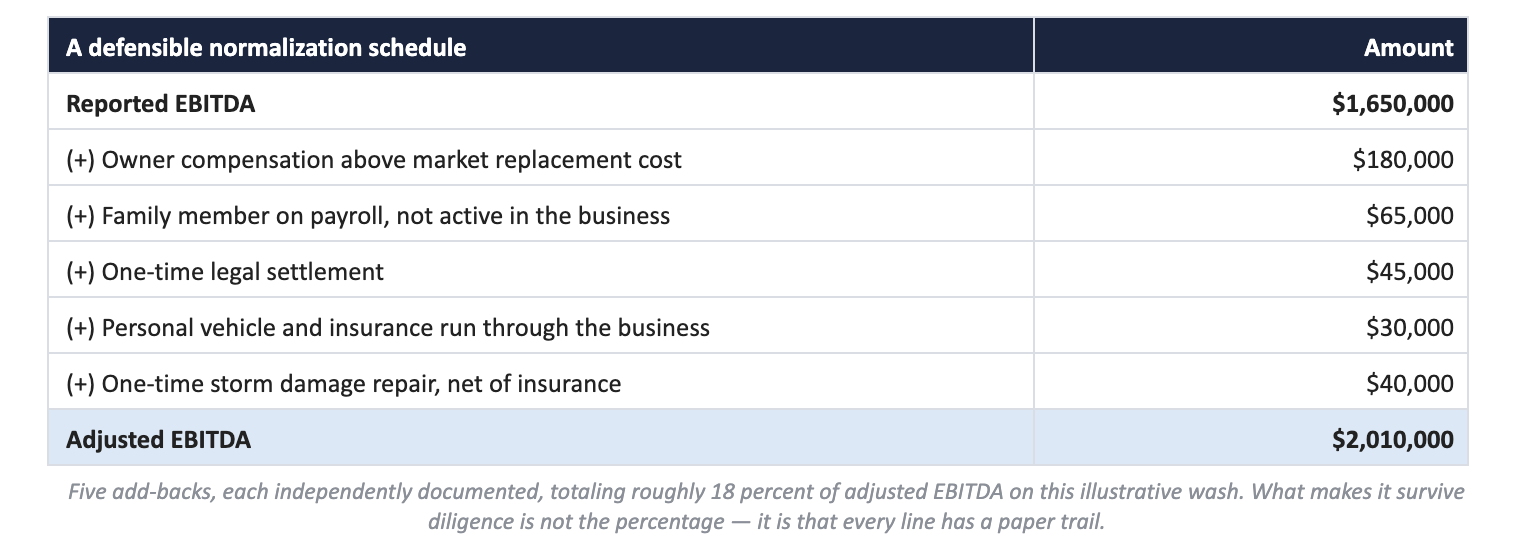
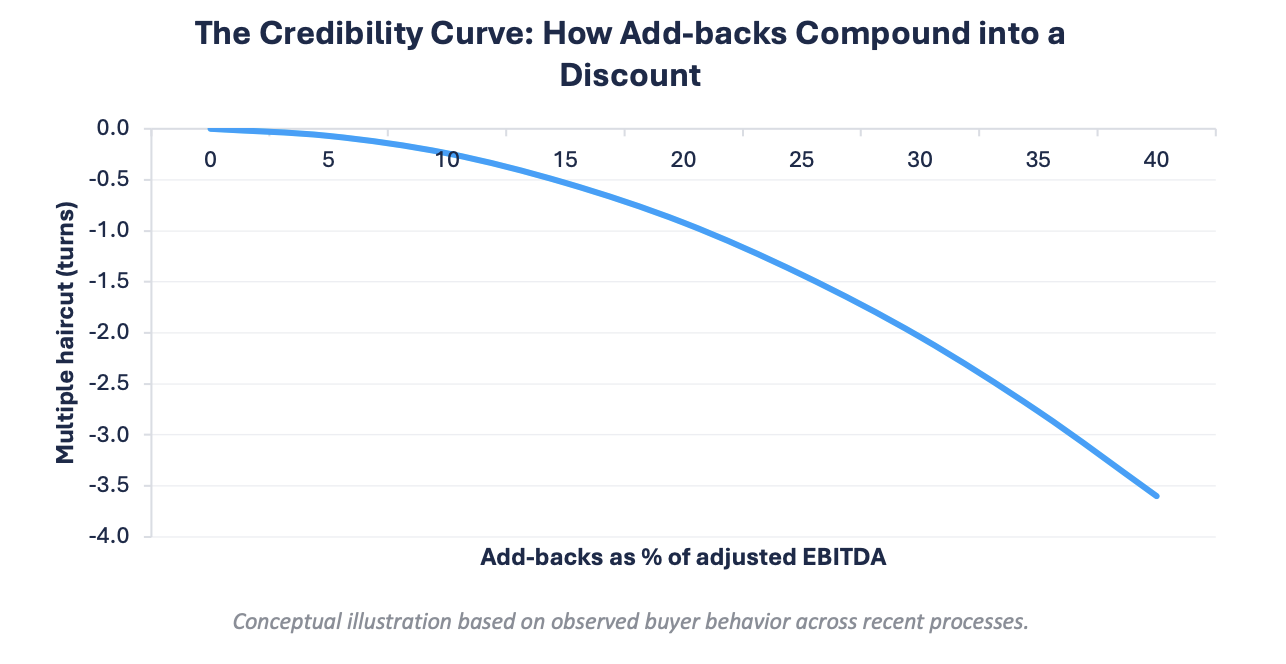
The problem is the P&L that arrives with fifteen add-backs worth 30 percent of EBITDA. At that point the buyer stops underwriting your numbers and starts rebuilding them from scratch, and their version is always lower. The discount is not linear. A few defensible adjustments cost you nothing. Past a certain point, every additional add-back costs credibility on the whole schedule. On a recent single-site engagement in the Midwest, the add-back negotiation moved the purchase price more than any other single item in the deal. Every add-back you eliminate before a sale is an argument you never have to win.
Cash off the books deserves its own callout because owners still raise it in first meetings. The honest answer: if it is not in the financials, it does not exist for valuation purposes. No credible buyer will pay a multiple on revenue they cannot verify, and raising it does worse than nothing. It tells the buyer your reported numbers may not be reliable either, which infects the multiple on the EBITDA you can prove. Unreported cash is not hidden value waiting to be unlocked at a sale. It is a discount you already took. There are ways to navigate this hurdle, and having a trusted advisor in your corner is a good place to start.
Then there is the data you cannot produce. When a buyer asks for monthly churn and the answer is a shrug, they price the uncertainty. Same with deferred capex. Buyers walk your tunnels with an equipment budget in mind, and a wash that needs $400,000 of catch-up spend will see it come out of the price, usually at more than dollar for dollar.
Commingled personal expenses, one entity running three sites and a landscaping company, missing site-level P&Ls. None of these kill deals on their own. Together they compound into the gap between what your wash earns and what a buyer will believe it earns.
Why Prepare Early?
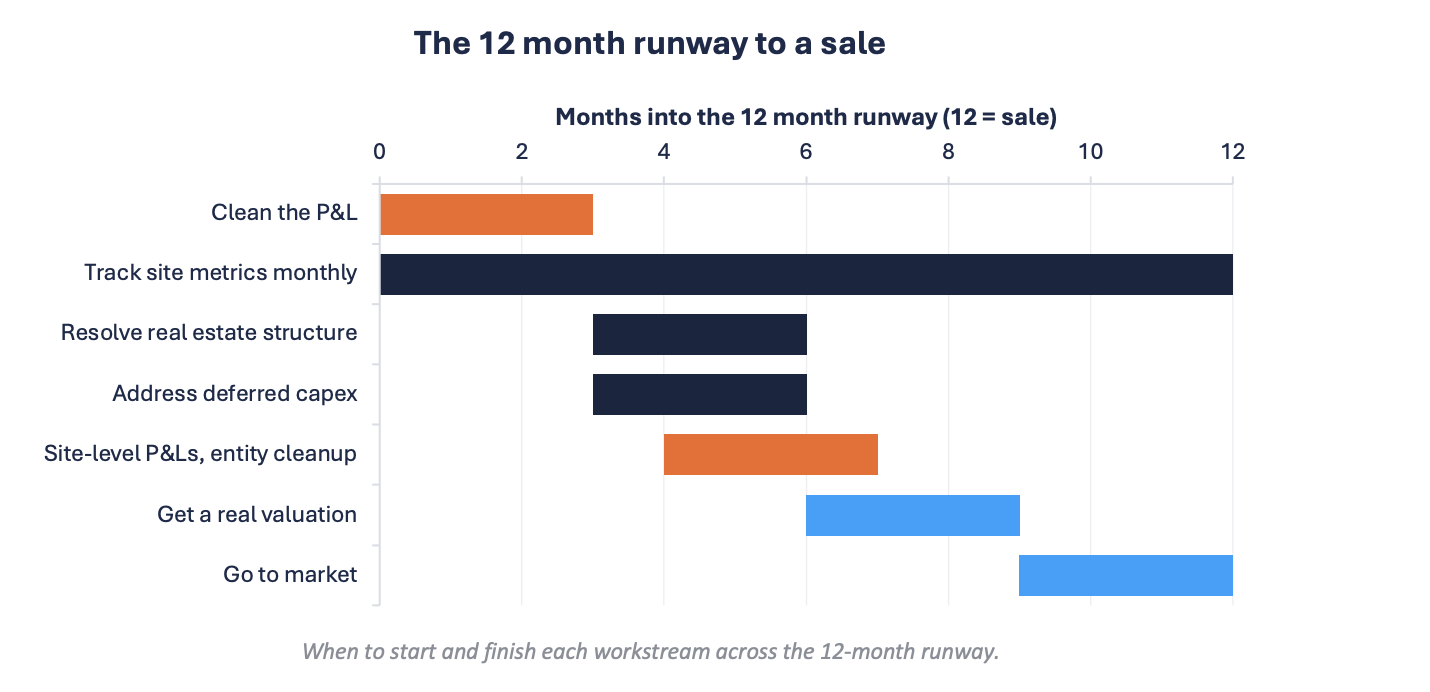
None of this is fixable in the middle of a process. Once a buyer is in your data room, every open question gets priced, and it gets priced against you. Twelve months is roughly how long it takes for clean financials to look clean, for cohort data to become an exhibit instead of an estimate, and for the real estate question to become a structure rather than a scramble.
This is the work we do with owners well before a sale is on the table. We tell you where the business sits today, which of the drivers above is costing you turns, and what your number looks like now versus a year from now. Engaging early is not about buying a valuation. It is about buying the time to change the inputs while changing them still moves the outcome. Owners who start twelve months out go to market with the guesswork removed, and that is what maximizes the outcome
The 12-Month Checklist
If a sale is on your horizon, here is where we tell owners to focus their attention twelve months out.
- Clean the P&L now. Move personal expenses out, take family members who do not work in the business off payroll, and get to a number that needs five add-backs or fewer. Every month of clean financials makes the next month more credible.
- Start tracking membership data monthly. Churn, new member adds, revenue per member, by site. Twelve months of cohort data is the single strongest exhibit in a modern car wash process.
- Resolve the real estate question. Decide whether the property sells with the business, stays with you on a lease, or gets sold separately. Get the lease terms or the appraisal work done before a buyer forces the issue.
- Address deferred capex or price it knowingly. Fix what is economic to fix. For the rest, get quotes so you control the number in the negotiation instead of the buyer’s contractor.
- Separate the entities and build site-level P&Ls. Buyers underwrite sites, not consolidated statements. Make your weakest site’s story legible so it does not drag the portfolio.
- Get a real valuation before a buyer anchors you. Know your number and know which of the drivers above is costing you turns, while there is still time to do something about it.
And if your timeline is shorter than twelve months, reach out to us directly. We will give you an honest read on whether the market is ready for your wash as it sits today, and what it is worth right now versus a year from now.
Final Thoughts
Your multiple will be the output of your business, not your neighbors from 2022. In the process described earlier, more than 30 buyers looked at the same wash, the same financials and the same market, and the winning letter of intent landed 2.75 turns above the lowest indication. On $2,000,000 of adjusted EBITDA, that is $5,500,000 of value that had almost nothing to do with the asset and almost everything to do with how the asset was prepared, the process execution and who was competing for it.
Those turns are the ones you control. Membership retention rather than membership count, knowledge of your real estate situation, a normalization schedule with a handful of defensible add-backs instead of fifteen, and site-level P&Ls that make your weakest site legible. None of that gets built in the middle of a process. It gets built in the twelve months before one.
Know your number before a buyer tells you theirs. If a sale is anywhere on your horizon, we are happy to give you an honest read on where your car wash stands today and what an exit plan could look like.

For more information, please contact:
John-Michael Tamburro
Strategic Advisor, Miracle, LLC
www.linkedin.com/in/johnmichaeltamburro
Important Disclosures
This article is provided by John-Michael Tamburro and Miracle, LLC for general informational and educational purposes only. It reflects the author’s own opinions and observations as of the date of publication and is subject to change without notice. It is not a recommendation, an offer to sell or a solicitation of an offer to buy any business, security or interest in any entity, and it is not investment, legal, tax, accounting or appraisal advice. Nothing in this article creates an advisory, agency or fiduciary relationship with any reader.
All figures, charts, tables and examples are illustrative and in certain cases hypothetical. They are drawn from the author’s own experience across recent transactions, have not been audited or independently verified, and are intended to demonstrate concepts rather than to describe any specific business or transaction. Hypothetical illustrations have inherent limitations and do not reflect actual results. Past transaction outcomes, valuation multiples and market conditions are not a guarantee or prediction of future results, and no representation is made that any owner will achieve comparable results. Every business is different, and individual outcomes depend on facts and circumstances specific to that business. Readers should not act or refrain from acting on the basis of this article and should consult their own legal, tax, accounting and financial advisors before making any decision regarding the sale, purchase, financing or valuation of a business.